AI Agents for Business: What NVIDIA's GTC Berlin Keynote Means for Your Company
On 21 October 2026, NVIDIA CEO Jensen Huang gave the keynote at GTC Berlin. Most coverage focused on hardware: Vera Rubin, AI factories shipped in containers, robotaxis. For a business deciding how to use AI agents, the useful part came in the middle, when Huang took an agent apart and named its pieces.


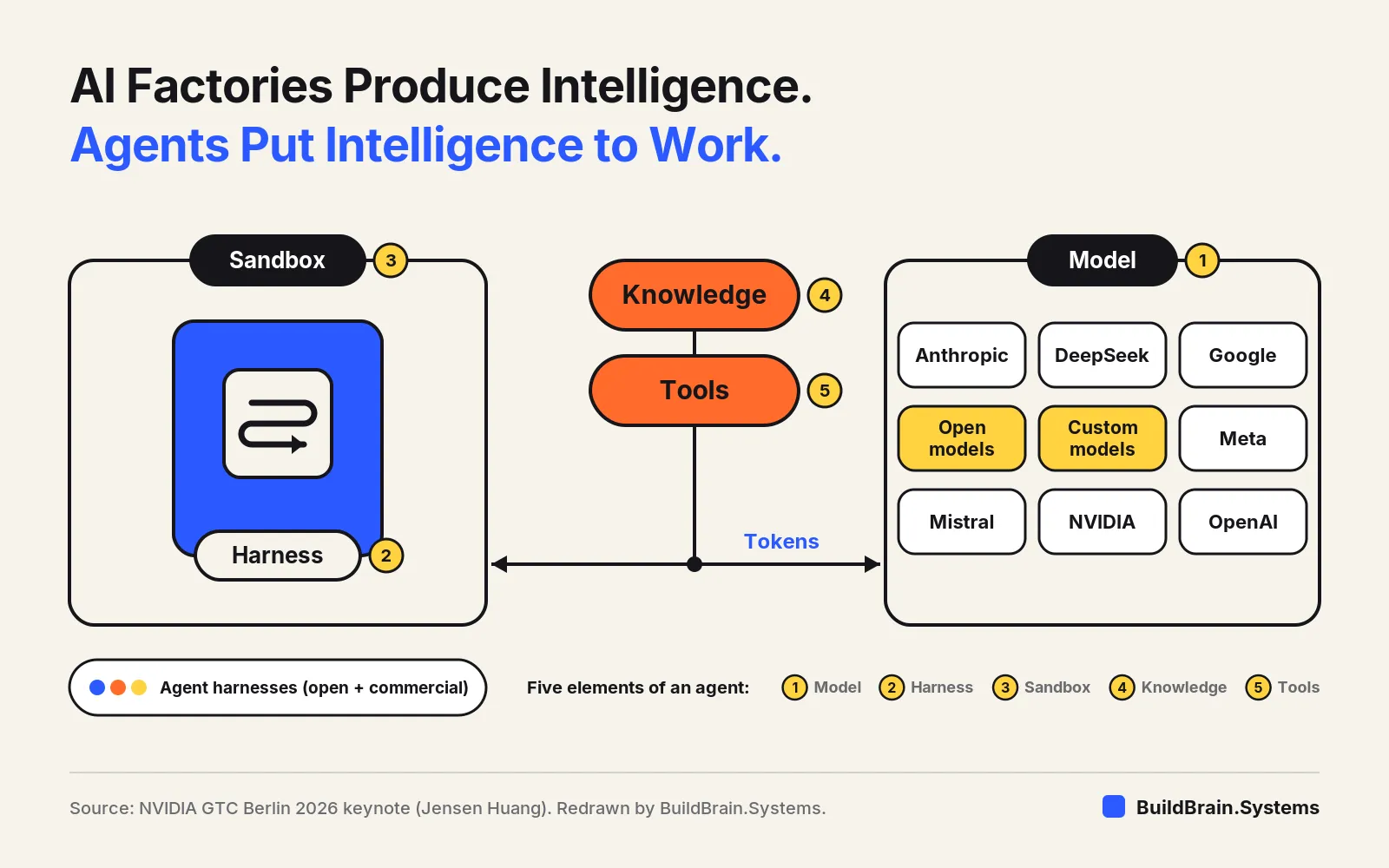
The five elements of an agent: model, harness, sandbox, knowledge and tools. Source: NVIDIA GTC Berlin 2026 keynote (Jensen Huang). Redrawn by BuildBrain.Systems.
His conclusion fits in one line. After walking through the model, the harness, the sandbox, the knowledge and the tools, he said: "Those knowledge and tools belong to you. That's your expertise."
That line is the business case for AI agents in a small or mid-size company. Here is how we read the keynote, and what to do with it.
"The very beginnings of a new industrial revolution"
Huang opened by saying that after decades of progress in computing, "we are now at the beginnings of a new industrial revolution," and compared it to electricity. Discount the stage optimism and the practical point remains: an industrial revolution changes how work gets done. For an operator, that means how quotes, orders, scheduling and support move through the business. A chatbot subscription alone doesn't get you there.
What is AI? Huang's answer: a manufacturing industry
Huang's framing was blunt: "AI is a manufacturing industry." It runs on computers, but it is no longer just a tool a person picks up. It has become machinery and infrastructure, factories producing intelligence that flows into every industry.
He described it as a five-layer cake:
- Energy, which powers
- Compute, housed in
- AI factories, which generate tokens from
- Models, which are built into
- Applications across every industry.
Most small and mid-size businesses will never touch the bottom three layers. You buy them by the token. The top layer, applications, is where your business lives, and it is where agents do their work. The slide behind him said it plainly: AI factories produce intelligence, agents put intelligence to work.
The five elements of an AI agent
Huang defined an agent as five parts:
- Model. The part that thinks: perception, reasoning, planning and deciding which tool to use.
- Harness. The software that orchestrates the work, manages memory and calls tools. Huang called it the agent's exoskeleton.
- Sandbox. The isolated space the harness runs in, separated from the rest of your systems.
- Knowledge. Your company's data, structured and unstructured, turned into something the agent can use.
- Tools. The software the agent uses to do real work, from spreadsheets and databases to simulators and design software.
The keynote's opening film put it simply: data becomes knowledge, knowledge becomes action. The model reasons; knowledge and tools turn that reasoning into finished work.
How to make AI agents useful: five steps for a business
Huang didn't present a numbered checklist. He said that before talking about how to make agents useful, the first priority is making them secure, and then he worked through each element. Here is that walkthrough turned into five steps an owner can act on.
Step 1: Fence it in before you switch it on
An agent can reach files, networks and tools on its own, so Huang's rule was minimal privileges and constant monitoring. He added that privileges change every time an agent is launched, depending on the task and the person using it.
NVIDIA's answer is OpenShell, an open-source secure runtime. You write a policy for what each agent may touch, and OpenShell enforces it at the level of system calls, file access and network connections. Credentials stay with a supervisor outside the sandbox, so the agent never holds the keys. As NVIDIA's demo video put it, "hope is not security."
For a small business, the lesson applies whether or not you ever run OpenShell. Decide what each agent can read, what it can change and what needs a person's sign-off before it goes live.
Step 2: Give each agent a harness and a clear job
The harness organises the work: which steps run in what order, what the agent remembers, and when it calls a tool. Huang named options from OpenClaw and Hermes to LangChain or plain Python.
The harness only works if the job is defined. An agent with one clear task and a known finish line is easier to secure, test and trust than a general helper. That's why we recommend one job per agent.
Step 3: Treat the model as a swappable part
Look at the slide again. The model box holds logos from Anthropic, Google, Meta, Mistral, NVIDIA, OpenAI and others. Huang said directly that companies will use many models, closed, open or custom, and pick the best one for each piece of work. General models handle generic work well. Work built on proprietary know-how can justify customising an open model on your own data.
The takeaway: don't build your process around one vendor's model. If you can swap the model without rebuilding everything else, each improvement in the market becomes available to you. When you compare options, price the finished task rather than the token.
Step 4: Build a knowledge foundation from your own data
Huang said what turns agents into "super agents" is access to your company's knowledge. NVIDIA announced an Agent Knowledge Foundation: models and libraries for reading documents, searching them by meaning, ranking the results, and making predictions from structured databases.
His example is worth borrowing because it looks like a normal week at most companies. A supplier emails to say a part will be late. That notice is unstructured text. Your orders sit in a structured database. An agent combines the two to predict which orders will slip and by how much, then searches your engineering documents for a replacement part.
Nothing in that example needs a new model. It needs your supplier emails, your order records and your parts documents to be findable and accurate. Getting that in order is most of what AI readiness actually involves.
Step 5: Hand it the tools of the trade
"The best engineer still needs simulators and solvers," NVIDIA's video said, and an agent is the same. Huang's examples came from Lila Sciences, Siemens and Dassault Systèmes, where agents were useful because they could run the specialist tools those teams already depend on.
For a 20-person firm, the tools are ordinary: accounting, CRM, scheduling, the estimating spreadsheet. Huang also predicted that software vendors will become agent companies. Expect the tools you already pay for to ship agents, and judge them by whether they fit your process.
Sovereign intelligence, at small-business scale
Huang's term for companies was "sovereign intelligence": post-train an open model on your proprietary data and own the result. Countries want the same thing at national scale, with their own compute and models.
A small business doesn't need to train a model to apply the idea. Sovereignty at your scale means three things:
- Your data stays organised in systems you control.
- Your process knowledge, meaning how you quote, schedule and serve, is written down rather than stuck in a few people's heads.
- You can change AI vendors without losing what the agent knows.
Your knowledge and tools belong to you
This is the takeaway Huang landed on, and it is the right one for owners. Models are rented and will keep changing. Harnesses and sandboxes are becoming standard, much of it open source. What a competitor cannot rent is your knowledge of your customers, your pricing logic, your exceptions and the tools your team has tuned over years.
Huang also said "building agents is not that hard." If building gets easier, what separates one company's agents from another's is what they are given to work with.
Where to start: map the process before you pick a model
Most agent projects stall because no one wrote down how the work actually happens. Start there:
- Pick one process that repeats weekly and costs real hours, such as order entry, quote follow-up or supplier updates.
- Map the process step by step: inputs, decisions, systems touched, who approves.
- Mark where the knowledge lives (emails, PDFs, databases, someone's memory) and which tools each step uses.
- Decide what an agent may do on its own and what needs a person's approval.
- Only then choose the model and harness, and keep the model swappable.
If you'd like help with that first map, a BuildBrain AI audit walks through one process with you and shows where an agent would save time and what it would need access to.
Frequently asked questions
What are the five elements of an AI agent, according to NVIDIA?
At GTC Berlin 2026, Jensen Huang listed them as the model, the harness, the sandbox the harness runs in, knowledge, and tools. The model reasons, the harness orchestrates the work, the sandbox isolates it, and knowledge and tools let it do real work.
What is NVIDIA OpenShell?
OpenShell is NVIDIA's open-source secure runtime for AI agents. Each agent runs in an isolated sandbox, and a policy controls which files, system calls and network connections it can use. Credentials stay outside the sandbox. NVIDIA announced an OpenShell Reference Architecture at GTC Berlin.
Do small businesses need their own AI models?
Usually not. Huang's advice was to use the best model for each job, whether closed, open or custom. Most small firms get more value from organising their own knowledge and connecting the right tools, and keeping the model easy to swap.
What does "sovereign intelligence" mean for a business?
In Huang's words at GTC Berlin, it means training an open model on your own data and owning the result. For a small company, it mostly means keeping control of your data and process knowledge so that you, not a vendor, own what makes your agents useful.
What is the first step to using AI agents in a business?
Map one repeating process: its steps, decisions, data sources, tools and approvals. That map tells you what the agent needs to know, what it may touch, and where a person stays in the loop.

Similar Articles



What does AI really cost a small firm? Run the calculator →
AI automation agency for small firms →
Business process mapping examples →
Microsoft Copilot cost for a small business →
AI consulting services for small business →
Free AI readiness assessment →
Pilot purgatory: the 90-day AI proof of concept test →