
AI Marketing for Small Business: Anyone Can Make the Post Now. Knowing What to Say Is the Edge.
An anime account turns breaking news into finished video within hours, and a one-person clinic posts to eight platforms in two hours a week. Stop operating the tool and build the loop: here is the trigger, draft, review, publish setup an owner can run, and the calls that stay with you.


AI marketing for small business used to mean a chatbot on the website. Now it means something bigger. The work of making marketing, the writing, design and video that once needed a team and a few weeks, can be done by one or two people in an afternoon. That changes what an owner should worry about. Making the post is no longer the hard part. Knowing what to say, when to say it, and whether it is true is the hard part now.
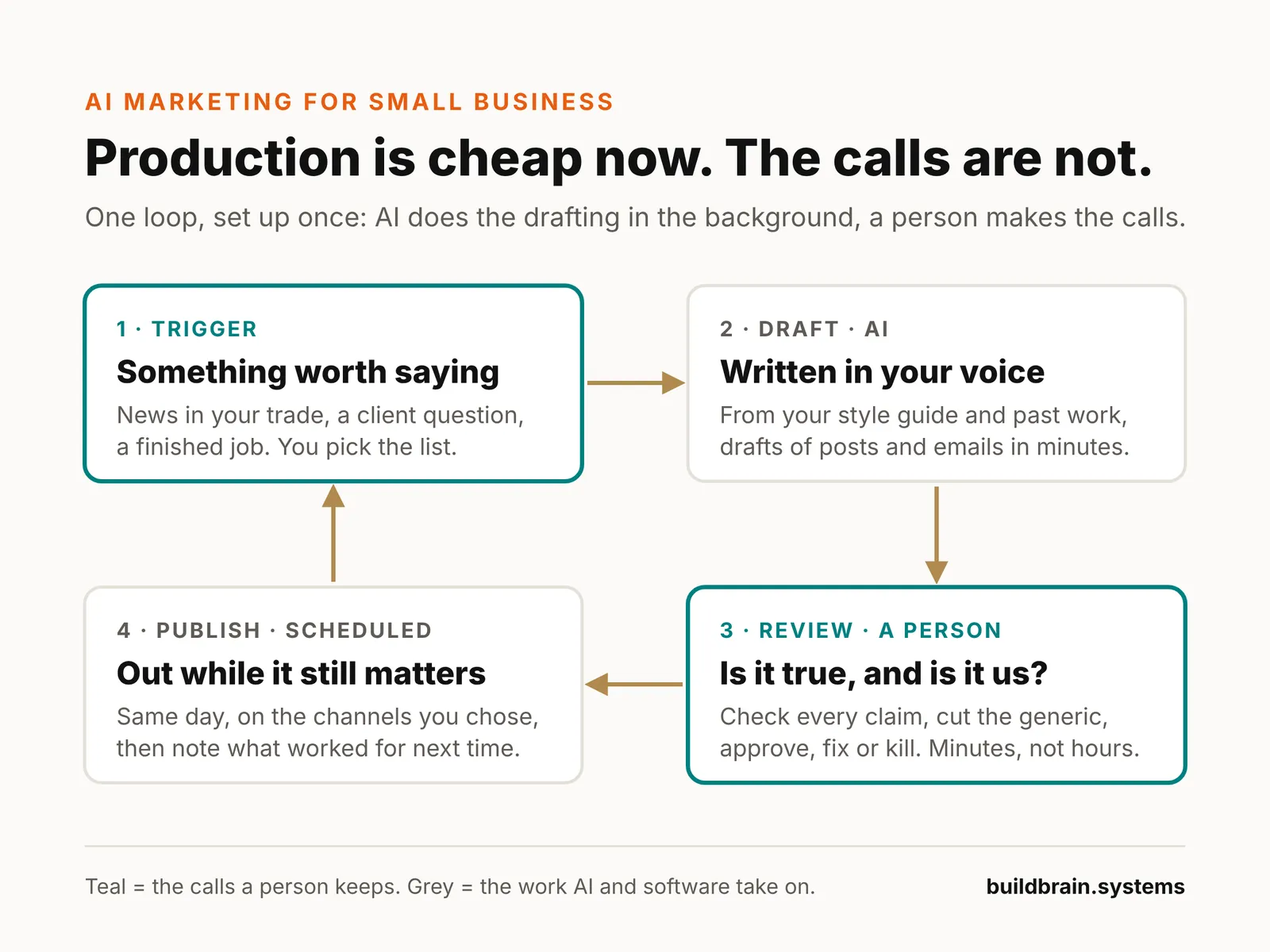
This guide shows the change through four real examples, then sets out a simple loop an owner can run: trigger, draft, review, publish. AI does the drafting quietly in the background. You keep the calls.
Source and label: the examples below come from news reports, an owner’s own write-up and the accounts’ own pages. The time figures are what the people involved said, not independent measurements.
What changed: a news story on screen as anime within hours
PsyopAnime is an anonymous account on X that turns the day’s news into short AI-made clips in the style of 80s and 90s anime. It joined X in June 2024 and had about 214,000 followers on 31 October 2026. Its bio calls it a meme account. Its own site calls it “an AI-driven animation studio” and sums up the method in one line: “Humans direct. Machines render.”
The speed is the point. Writer Xander Seren tracked one clip in June 2026: the story was first reported at 6 a.m., and the account posted a finished 1-minute-18-second video about nine hours later. Seren also describes screenshots the creator shared of a custom tool that pulls breaking stories from major outlets, ranks them on settings such as “urgency,” “controversy” and “brand fit,” and turns the winners into a brief for an AI video tool.
Animation like that used to need a studio of artists, plus someone watching the news, and weeks of lead time. We are not holding the account up as a model for tone. Its subjects are often political and its replies get rough. It is here because it shows the new shape of content work very plainly: a sharp trigger, a short brief, machine-made production, and a person deciding what goes out.
Three plainer examples from very small teams
One person, a TV ad in two to three days. In June 2025 filmmaker PJ Accetturo made a fully AI-generated ad for the prediction-market company Kalshi that aired during the NBA Finals. The Verge and Business Insider reported the process: a rough script, an AI assistant to turn it into shot-by-shot prompts, Google’s Veo 3 to generate the clips, and an ordinary video editor to finish. In his own write-up, Accetturo says it took 300 to 400 generations to get 15 usable clips, with one person working for two to three days. Note the ratio. Most of the output was thrown away, and choosing what to keep was the real work.
A one-and-a-half-person clinic, eight platforms in two hours. April Martinez, a naturopath who runs a clinic in Rawlins, Wyoming, told the Saratoga Sun (via the Wyoming News Exchange, October 2026) that posting to eight social platforms each week would take her 10 to 15 hours without AI. Now it takes about two. She built an assistant loaded with her market profile, a style guide and her own material, so it writes from what she knows rather than the open internet. She still reads every blog post before it goes out. “AI lies,” she said.
Solo operators, more output and more dinners at home. Business Insider spoke to solo business owners in February 2026. Independent journalist Georgia Fort uses AI to format her newsletters and social posts and to cut video clips, and estimates it frees five to ten hours a week for reporting. Dusti Arab, who runs a small marketing firm, dictates voice notes through the day and uses AI to turn them into briefs. “If you use AI to process the brain dump first, the deliverable comes out way better,” she said.
When making it is cheap, what is scarce?
Look at what these examples have in common. None of them won on production; anyone can get production now. Each won on one of three things AI does not supply on its own:
- The trigger. Knowing which moment is worth a post. PsyopAnime ranks stories before it makes anything. Martinez posts from a market profile she wrote, not from whatever the tool suggests.
- Judgement. Choosing 15 clips out of 300 or more, and binning the draft that is technically fine but off-brand.
- Quality of thought. Having something true and useful to say. Arab’s line is the whole idea: the thinking goes in first, and the draft is only as good as that.
So the job for an owner shifts. It is less about finding someone who can make content, and more about writing down when you speak, what you stand for and who signs off. That is a process, and a process can be mapped before any tool is chosen.
Stop operating the tool. Build the loop.
Most owners use AI as operators. Open the chat, type a prompt, copy the answer, paste it somewhere, check it, and do it all again tomorrow. You are still doing the work; the AI is a faster pen.
Builders write down the trigger, the inputs, the steps and who reviews, once. Then the work runs without them.
To paraphrase Proton’s CTO: “Your job is not to use agents to help you write code. Your job is to lead the agents to help them write code.” Swap “code” for posts, emails or videos and it holds for any owner.
James Cortada, who spent 38 years at IBM, frames modern firms as “giant information-processing machines” in Information and the Modern Corporation (MIT Press). That processing used to be people’s work. Now agents can do most of it, cheaper and faster, while you make the calls. Your job is to design how yours runs, not to type into it.
One marketing loop looks like this:
News alert in your trade → AI drafts a post from your voice file → you approve, fix or bin it the same day → the scheduler publishes → one line in the log.
The steps below show how to set it up.
How to set up a trigger, draft, review, publish loop
Do this for one channel first, such as your email list or one social account. Each step takes an hour or two to set up, and after that it runs mostly in the background.
1. Write down your triggers
List the moments that should lead to marketing. Good ones for a small business: a job finished (with a photo and the client’s OK), a question clients keep asking, a change in your trade or local rules, a season or deadline your customers face, a new review. Next to each, note where it shows up: a stage in your CRM, a folder, a news alert, an inbox label. If it doesn’t show up anywhere, nobody will notice it in time.
2. Build a one-page voice file
Who you serve, what they worry about, the words you use, the words you never use, the claims you can back up, and three or four past pieces you were proud of. Load it into the AI assistant as standing instructions, with your own articles and FAQs as its reference material. This is what stops the drafts sounding like everyone else’s.
3. Let AI draft, in the background
When a trigger fires, the assistant gets a short brief: the trigger, the channel, the one thing to say and the call to action. It returns a draft, or two or three short options. This can be as simple as a saved prompt you paste a note into, or set up so a new CRM stage or form entry sends the brief automatically. The draft lands in one place: a shared doc, a folder or a queue in your scheduler.
4. Name the reviewer and the rule
One person reviews, and the rule is written down: check every fact, number and name; check anything about health, money, law or a client against your own records; cut anything generic; then approve, fix or bin it. Set a time limit, such as same day for anything tied to news and within a week for evergreen posts. If nobody has time to review, the loop is not ready, and that is useful to know.
5. Publish on a schedule
Approved pieces go into your scheduler or email tool for the channels you chose. Speed matters most for news-driven posts; a useful post a day late is often worth more than a careless one an hour early.
6. Keep a one-line log and prune
For each piece, note the trigger, whether it was approved as drafted or rewritten, and how it did. After a month, drop triggers that never produce anything good and update the voice file with the fixes you keep making. That is how the drafts get better without you spending more time on them.
What stays with a person
- Deciding which triggers count, and which news you stay out of.
- Any claim about results, prices, health, money or the law.
- Anything that names a client, or uses their photos or words.
- Replies to complaints and to anyone upset.
- The final yes before it publishes.
AI marketing tools for small business, by step
You likely own most of this already. Trigger: news alerts, RSS feeds, a CRM stage, an inbox label or a shared folder. Draft: a general AI assistant such as ChatGPT, Claude or Gemini, loaded with your voice file; design tools such as Canva for images. Review: a shared doc, or the approval step in your scheduler. Publish: your social scheduler and your email platform. Pick the tools your team will actually open. The loop matters more than the brand of any one tool, and BuildBrain doesn’t sell any of them.
Start with one loop
Pick the marketing you keep meaning to do and never get to: the monthly email, the after-job post, the answer to the question every client asks. Write its trigger and its reviewer on one page. Then add the AI.
If you want help, our process mapping service starts with one loop, and our AI workflow automation work wires the trigger and the draft so they run quietly. For why the review step matters, see the risk of unreviewed AI output and AI marketing risk for law firms. Any build is a fixed fee, agreed before work starts.
Tell Ada which marketing job you never get to. She will send back a free one-page sketch of a trigger, draft, review, publish loop for it at /audit/.
Frequently asked questions
How can a small business use AI for marketing?
Mostly for drafting. Give an AI assistant your style guide and past work, and it can turn a trigger (a client question, a finished job, news in your trade) into a draft post, email or blog outline in minutes. A person then checks it, fixes it or bins it, and the approved piece goes out on a schedule. The saving is in production. Deciding what to say, and when, stays with you.
What is the best AI marketing tool for a small business?
Usually the general AI assistant you already pay for or can try free, such as ChatGPT, Claude or Gemini, plus the design, email and scheduling tools you already use. The tool matters less than the loop around it: a written list of triggers, a voice file, a named reviewer and a publish step. BuildBrain doesn't sell any of these tools.
Will AI-written marketing hurt my brand?
It can if it goes out unread. AI drafts sound generic by default, and they can state things that are not true. One owner quoted in this piece reads every post before publishing because, in her words, “AI lies.” Keep a person on the review step, check every claim, and rewrite anything that doesn’t sound like you.
How much time does AI marketing save a small business?
The figures available are self-reported. A one-person clinic owner in Wyoming says posting to eight platforms went from 10 to 15 hours a week to about two. A solo journalist in Minnesota estimates five to ten hours a week freed up. Treat these as what the owners said, not a forecast for your business.
Should I hire an AI marketing agency or set it up myself?
If you can name your triggers and someone on your side can review drafts, you can usually run the loop yourself. An agency makes sense when nobody has time to review, or you need production you can’t do in-house. Either way, you keep the calls about what to say. An agency should be able to show you its review step.
Do I need to learn to prompt AI for marketing?
Not much. Clear instructions help, but the bigger gain comes from designing the loop: what starts the work, what information goes in, which steps run and who checks. Write that down once and the prompt becomes one small part of a process that runs without you typing into a chat every day.
Sources: PsyopAnime, X profile (follower count and join date read 31 October 2026) and About page; Xander Seren, “Everything Gets a Custom Skin,” 21 June 2026; The Verge, Kalshi’s AI-generated NBA Finals ad, June 2025; Business Insider, the prompts used to make the Kalshi ad, June 2025; PJ Accetturo, own process write-up (self-reported); Leea Smith, Saratoga Sun via Wyoming News Exchange, “Small businesses embrace AI but some designers, customers warn its use may come with a cost,” October 2026; Business Insider, “AI is helping solo business owners work faster, think bigger, and stress less,” February 2026. Time savings are as reported by the people quoted. Hero diagram: BuildBrain.; James W. Cortada, Information and the Modern Corporation, MIT Press (publisher’s description)
Similar Articles



What does AI really cost a small firm? Run the calculator →
AI automation agency for small firms →
Business process mapping examples →
Microsoft Copilot cost for a small business →
AI consulting services for small business →
Free AI readiness assessment →
Pilot purgatory: the 90-day AI proof of concept test →